|
Fall 2007 |
|
|
Spa 1102 - Study
Guide for the Final Exam |
|
|
Vocabulary |
Colors,
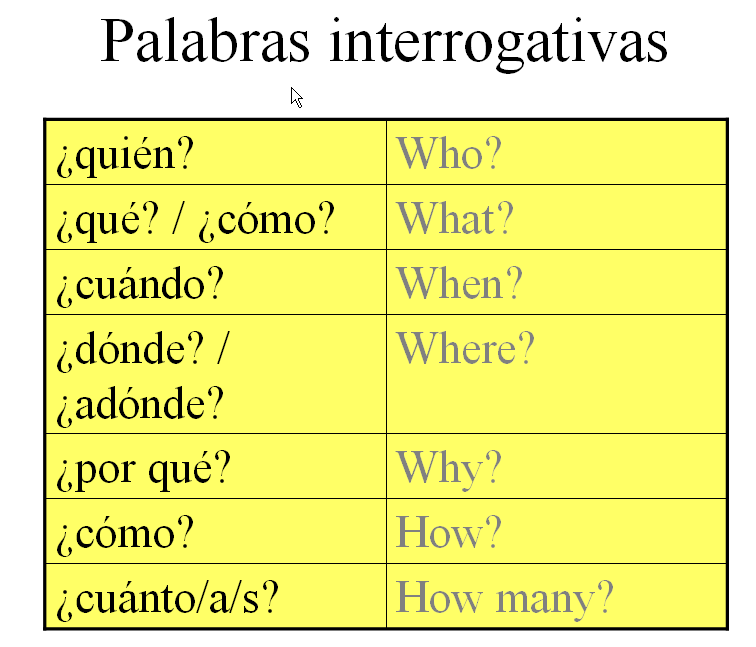
clothing, question
words (1),
family members (1,2,3), physical
attributes and general character traits [64], descriptive
adjectives (2)
[69], tener idioms, days of the week(1), the house and furniture, the various world nationalities
[70], climate,
months and seasons, special
adjectives (172), prepositions of place and time (1), food and food
dialogue, verbs as vocabulary, and general vocabulary at the end of each
chapter. |
|
Expression |
What
are the rules for dividing a word into syllables? How do you find the
naturally accented syllable of a word? |
|
The
Small Stuff |
Do
you remember a few of the secrets to learning Spanish? ( Review) Can you show possession using the Spanish
equivalent of an apostrophe “s” and also using an equivalent possessive
adjective? Do you remember what happens to "a" and "de"
when they are next to "el"? Can you tell time? What about adjective
agreement? When do you use “son las” as opposed to “a
las”? Do you
know why and when to use the personal “a”? Have you learned the noun-number
agreement scheme well (1,2)?
Have you considered the special prepositions like “conmigo”, “contigo” [162]
or the adjectives that frequently are used with the verbs ser and estar [172]? Do you know how to construct indefinite and
negative sentences? When does the placement of the negative expression require
an additional NO or negative before the verb?Have
you studied the "mouse” and “cat” diagrams? How many prepositions of
place are there? How many nationality suffixes (for example, estadounidense or mexicano) are
there? |
|
Grammar |
Have
you learned all the "tener" idiomatic
expressions? Can you create sentences using the "tener
+que", "ir + a" , "poder+", "querer
+", etc. structures? When do we use the progressive verb tense (1)? How do you form it? How
do you use the “gustar”
verb in a question? What should you know about the indirect object pronouns
“le” and “les”? (Review) When do we use demonstrative adjectives (1,2)? Which
spatial relationships are implied by each type of demonstrative adjective?
How does a demonstrative adjective become a demonstrative pronoun? What
is the difference between “ese” and “eso”? Extra practice?
How many –AR ,-IR, ER verbs
do you know (1)?
Have you studied them as vocabulary and also in all of their “conjugations”? |
|
|
|