|
SPA
1101 |
Fall 2007 |
|
Study Guide for the Final Exam |
|
|
Vocabulary |
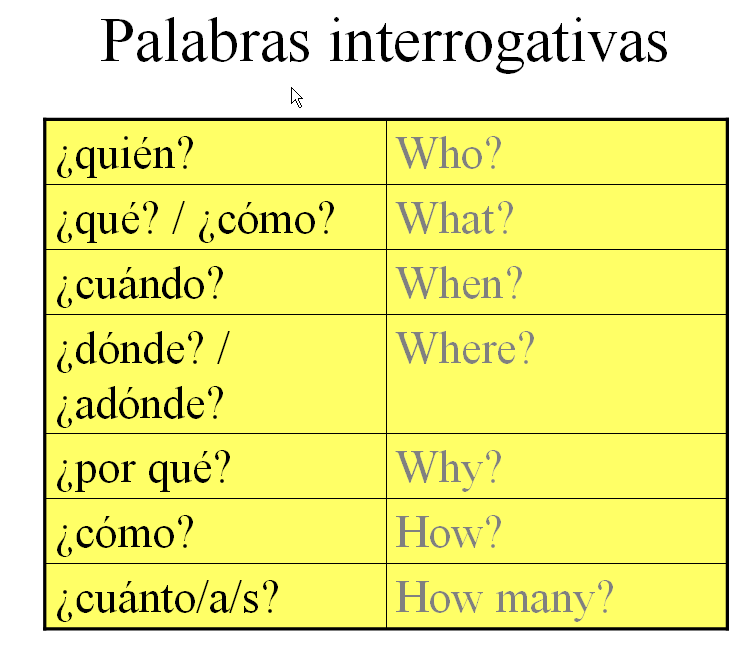
Common greetings, descriptive cognates, numbers 1-1000+, time, family and extended family members (1,2,3), physical attributes and general character traits [64], pets, the various world nationalities [70] and languages, question words (1), descriptive adjectives (2) [69], classroom objects, course subjects, university buildings, clothing (1,2,3), fabrics, colors, tener idioms, adverbs of frequency, conjunctions [and, but, or], prepositions [to, from, on, of, at], verbs as vocabulary, and anything else in the general vocabulary lists at the end of each chapter. |
|
Expression |
Do you remember a few of the secrets to learning Spanish? ( Review) Can you spell out the sounds of the Spanish alphabet? (Review) What are the rules for dividing a word into syllables? How do you find the naturally accented syllable of a word? What are the most important oral survival questions at this point in your quest to learn Spanish? (Review) Which consonant-vowel combinations have special sounds? (Review) Why are the "sticky" vowels so important? Can you explain when and why you would use "tú" versus "usted”? How many greetings and expressions of courtesy have we learned? (Review 1,2) How many pairs of basic conversation question-answer combinations can you come up with in Spanish? (Review) What are the two ways can we use to answer a question negatively? What does the second “no” in a negative reaffirmation answer mean? Are you able to generate more than a couple of simple conversation questions with our new vocabulary and verbs? If you were asked to generate a simple conversation, how far could you go? Are you able to create a simple dialogue that now includes vocabulary and expressions from Chapters Ante Todo – 3? |
|
The Small Stuff |
What
have you learned about cognates? (Review) How do we use the sentence structure
"me gusta" or the sentence structure "¿A qué hora
…?" Do you know the difference
between a definite and an indefinite article?
Can you create plural definite and indefinite articles? Are you keeping track of all the small
changes in Spanish (for instance, the a+el=al
combination, noun-adjective agreement, noun-verb agreement, or the difference
between the adverb “ |
|
Grammar |
What are the subject pronouns in Spanish? How many –AR, -ER, and -IR Verbs [80] should you know? Need some practice (1,2,3, 4,5 )? Are you using and conjugating the verb “ser” and "estar" correctly? When do you use the verb "estar" versus the verb "ser"? More practice (1,2)? How do you use the “me gusta” expression in a question? What should you know about the indirect object pronouns “le” and “les”? What does the “hay” verb mean? How is it used? How do you express age in Spanish? Did you remember to study your verbs as vocabulary words and also drill their conjugations? Are you able to conjugate the verb "Tener"? How is this verb related to the expression of age in Spanish ([63]? How many tener idioms are there? How many stem changing verbs are there? What are the forms of the verb IR? Do we conjugate both of the verbs in a compound verb structure? What should we remember to do if we create a compound verb using expressions like IR+a, TENER +ganas +de, or TENER+que? Can you create sentences using the "tener +que", "ir + a" , "poder+", "querer +", etc. structures?Have you reviewed less stressed verbs like “comprar” and “vender”? Can you conjugate the stem-changing verb like “costar” or “poder”? Need more practice with tener, venir, preferir, querer, poder--(1)? |