Spa 2202
Guide for the Final Exam
- Accents and Punctuation: Do you remember how to divide a word into its basic syllables? Where does the natural accent fall in Spanish? Why are the "sticky" vowels so important? (Review)
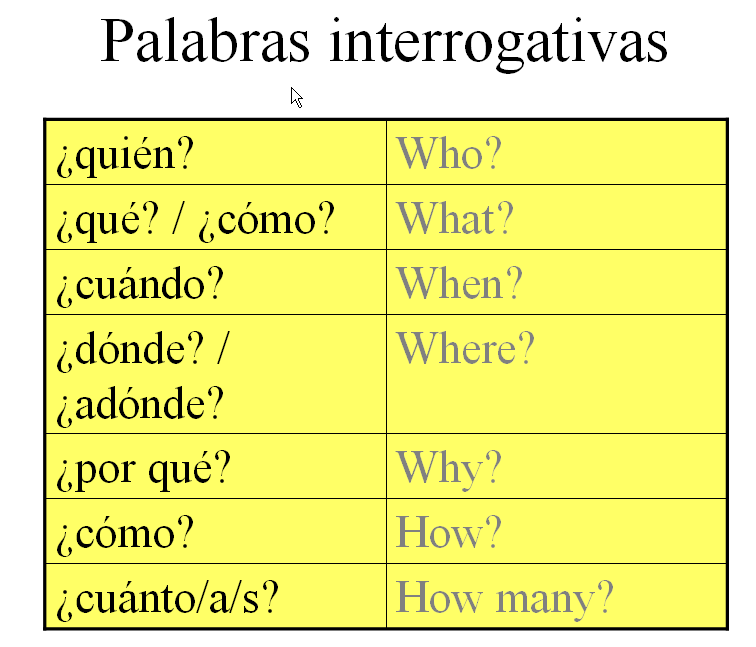
- Survival Sentences: What are the most important oral survival questions at this point in your quest to learn Spanish? How many questions words have we learned?
3. Preterit: Can you conjugate the list of REGULAR PRETERIT verbs? Have you been studying the regular preterit tense as well as the semi-irregular preterit tense? How many verbs have spelling changes to preserve a hard C or G sound? Which stem-changing verbs change in the preterit tense? When do they change? According to the professor's system of conjugating (the zig-zag method), how many semi- irregular preterit verbs are there? How many base-changing verbs should you know? What are their base changes? How do you conjugate irregular verbs like SER, IR, and DAR? How does the meaning of verbs like "poder", "saber, "conocer", and "tener" change when they are conjugated in the preterit tense?
4. Imperfect: How do we conjugate verbs in the imperfect tense? What three verbs are irregular in the imperfect tense? Do you recall when to use the imperfect (“description”, “habit”, “repetitive description”, and “ongoing but uncompleted action”)? Can you describe both in the present and past tense a few of your pastimes? What did you do/used to do? Where did you go/used to go?
- Preterit versus Imperfect: When do you use the preterit tense versus the imperfect tense? What system of rules have we developed to answer this question? How important is context in determining which past tense to use? Do you remember the underlying scheme that helps determine when to conjugate a verb in the preterit as opposed to the imperfect tense? Could you write a paragraph in the past and conjugate each verb appropriately using this underlying scheme? Would you be able to complete a CLOZE paragraph using these past tenses? Can you identify in preterit and imperfect tenses in oral communication?
- The Impersonal SE and the Passive SE (Finally on Quiz): What are the four ways that SE can be used in a sentence? What is the likelihood of using each type of SE? What contextual clues can you use to determine how SE is being used? When using SE to express the impersonal voice, can the verb be conjugated according to any subject or just the singular plural? How is a passive SE sentence constructed? How does it differ from the impersonal SE sentence? In what typical situations do you find the impersonal SE being used?
- Adverbs: How do you create an adverb using the suffix “-mente” (293)?
- Por versus Para: Can you determine when to use the preposition “por” versus the preposition “para”? Do you remember the square paradigm for these prepositions? Have you memorized the list of fixed or idiomatic phrases on page (289)? Which preposition is used for comparison? Which one is used to construct passive voice sentences with the verb SER?
- Commands: How do you form the imperative tense? What makes commands different from the subjunctive tense both in terms of form and in terms of sentence structure? Have we learned an acrostic that helps remember the irregular forms of the command? How do formal and informal commands differ in form? Did you remember to review the “vosotros” and “tú” commands?
- Subjunctive Form: How do you form the subjunctive tense? Do you remember how to conjugate stem-changing verbs? What happens to these verbs in the subjunctive form? How many irregular verbs do you know (ser, estar, ir, tener, dar, decir,, saber, etc.)? Do these verb have irregular forms in the subjunctive? The acrostic DISHES may help you remember these:

- Subjunctive Use: How many verbs of desire (306) and emotion (327) have we learned? What is the difference between a nominal, adjectival, and adverbial phrase? What conditions in the independent clause will force the nominal clause to be conjugated in the subjunctive tense? In which clause do you find the subjunctive tense? What conditions in the independent clause will force the adjectival clause to be conjugated in the subjunctive tense? How many adverbial subordinate conjunctions have we learned? What conditions in the independent clause will force the adverbial clause to be conjugated in the subjunctive tense? With exceptions like “ojalá” and “quizá”, how many clauses must there be in a subjunctive sentence?
- Vocabulary:
1. Travel (285)
2. Vacation experiences and the Airport (299)
3. Body Parts, Medicines, and Common Remedies (321)
4. Diet (333)
5. Verbs related to doubt, desire (306), and emotion (327).
6. Professions and the Interview Cycle