|
SPA 2201 Intermediate Spanish I Spring 2004 |
|
|
|
|
|
Prof.
William Keeth E-mail:
|
Tel:
570-662-4605 or 570-662-4581 Office:
Belknap 110-C |

Course Description:
Intermediate Spanish I (SPA-2201) continues the communicative based study of Spanish begun in SPA 1101 and SPA 1102. Like these prerequisite courses, it stresses the development of the four language skills (speaking, listening, reading, and writing) within a cultural context. In this course, students can expect to both review and buildupon the grammar concepts learned previously; however, more emphasis will be given to fluency and accuracy in spoken Spanish and to cultural awareness. The materials used in class will reflect a variety of cultural situations and geographic realities. As a result, one should anticipate evaluation (in either oral or written format) that reflectsthis focus. Pronunciation, vocabulary, geographical and cultural information, grammatical structures, readings, listening material, and language production will all form part of class evaluation.
Required Material:
Texts:
Kupperschmid
et al. Un paso más: An
Intermediate Spanish Course. New York: Mc
Graw-Hill, 1990.
Kupperschmid et al. Un paso más: Cuaderno/Manual de laboratorio.
Other:
A package of Index Cards and a Spiral Notebook
http://faculty.mnsfld.edu/wkeeth
http://www.mhhe.com/socscience/worldlanguages/spanish/home_spanish.mhtml
Suggested Material:
Texts:
The
Farell, Edith R. Side
by Side Spanish & English Grammar.
Keenan, Joseph J. Breaking
Out of Beginner’s Spanish.
Noble, Judith. Complete
Handbook of Spanish Verbs.
Spinelli, Emily. English Grammar for Students of Spanish.
Course Goals:
• Increase pronunciation skills and recognition of vocabulary.
• Ask and answer questions.
• Extend basic survival Spanish skills and vocabulary, so as to
discuss or write about interests, experiences, opinions, and perceptions in
Spanish.
• Lengthen utterances and group ideas into paragraphs and
narratives.
• Narrate and understand narration in the present, past, and
future tenses.
• Begin to support opinions, hypothesize, and discuss abstract
topics.
• Speak Spanish as much as possible under controlled circumstances
(casual talks, classroom discussions, dialogues, questions, and literary
debate.)
• Broaden one’s geographical and cultural competencies.
• Develop basic reading (journalistic and texts) and writing skills
(short paragraphs) in Spanish.
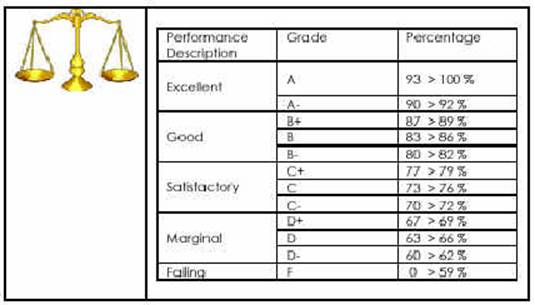
System of Evaluation:
|
Standards of Measurement |
Criteria and Weight |
|
|
Class Attendance: …………………..5% Class Journal: ………………………5% Homework:………………………….5% Oral Competency:…………………...5% Compositions: ……………………..10% Quizzes (3): ………………………..20% Midterm: …………………………..20% Oral Presentation: …………………..5% Final Listening Exam: ………………5% Final Exam: ………………………..20% |
|
Important
Dates |
|
|
February 6th, Quiz 1 |
February 27th, Midterm |
|
March 3rd, Composition 1 |
March 29th, Quiz 2 |
|
April 16th, Composition 2 |
April 19th, Quiz 3 |
|
April 26th-28th, Oral
Presentation |
April 30th, Listening Final |
|
May 5th, Final Exam |
|
Class Attendance:
All students are expected to attend every class. Missing a class does
not release a student from any class obligations. Students should keep in touch
with classmates and be sure to contact their professor in advance of any
absence. Any absence will result in a 15% reduction in the student’s
Class Attendance grade. The professor is NOT obligated to
assist students in making-up work missed due to an official field trip, due to
an official university function, or due to an illness. Students, however, MAY
request permission to miss a class and arrange to make-up missed work prior to
their absence. This type of arrangement can wave the 15% attendance reduction,
but MUST be completed at least 24 hours prior to an absence or illness.
Students MAY be required to provide documents supporting their request.
Electronic submission of written work is an effective way of handing in
required written work by a specified deadline, especially when a student
expects to be absent.
Journal and Pen Pal:
Via the Internet,
students are able to directly access information from Spanish speaking
countries, listen to the radio or watch TV in Spanish, and even communicate
with native-speakers. For this reason, students in this class will need to find
a Spanish speaking Pen Pal over the internet or will need to correspond weekly
with a classmate via e-mail. This correspondence should reflect common day
experiences and topics. Each week a printed copy of this correspondence and any
notes taken during class or at home will need added to the Class Journal. The
Journals will be collected and graded on a random basis throughout the
semester. The purpose of the Pen Pal correspondence and the Journal is to allow
students to expand upon and review their class material—one of the most
essential parts of a foreign language class.
Homework:
Exercises in the
Workbook/Laboratory Manual should be completed and self-corrected in a timely
manner in the Lab and/or at home. Please make corrections with a different
color pen. These exercises may be checked/graded in
class daily or handed in upon request. No late lessons will be accepted. The
purpose of these activities is to drill and practice essential areas of study.
Oral Competency:
Oral competency
will be tested throughout the semester by giving students informal oral
activities, questions, and/or pop quizzes during class. Oral competency will be
measured by how well a student answers simple questions, performs oral
activities, or responds to oral quizzes in class. If a student can communicate
an idea, it will be assumed that a "good-faith effort" has been made.
On the other hand, refusing to answer, answering in English, or answering in a
strange or inappropriate manner will prevent a student from earning a high
grade. It will be assumed that a student will be able to converse without using
his/her notes. If they are used, this will tend to lower the oral grade.
Compositions:
During this course,
students will prepare two typed compositions (Times New Roman 12, double
spaced). The first one will be a one-page letter to a friend and the second one
will be a two-page or longer exposition related to a Hispanic cultural
practice. The second composition should have a purpose and/or introduction,
body, conclusion. The instructor will provide further information regarding
each composition’s preparation.
Quizzes:
Quizzes allow the
instructor to test student internalization of the grammatical aspects, listening, reading, and writing
skills, as well as, the cultural, literary, and geographical
information presented in class. Please
note: quizzes cannot be made up.
Midterm and Final Exam:
These tests are
comprehensive written examinations. They usually consist of two sections: a
listening-comprehension section and a written section. Like exams, they cannot
be made up.
Oral Presentation: In a three to
five minute oral presentation, students will expand upon the theme of their
second written composition. For instance, they may describe and field questions
related to a historical event, site, or cultural and/or artistic tradition that
characterizes the country they have chosen. More detailed information will be
provided in class.
Study Method:
Students should
try to spend more time study the most difficult topics first and should always
study in short periods (an hour that includes a 5 to 10 minute break). Creating
and sticking to a study schedule is very important. Weekends can represent valuable
moments for studying more difficult areas. If, for some reason, a student
begins to feel that the demands placed upon his/her time, energy, and intellect
are unremitting; s/he is expected to seek both the professor’s help and outside
tutoring.
Conduct:
Academic honesty,
the submission of original work, and student interaction is expected in this
class. Any form of cheating may result in failure of the course. Additional
information concerning academic honesty can be found in the Password.
The Syllabus:
This syllabus
serves as a contractual agreement. Presence in this class means that you agree
to the items stipulated in the syllabus and are aware of any modifications made
throughout the semester. One should periodically check the course web site for
any updates to the syllabus and/or class calendar.
Class records and Grades:
Oversee your
grade by monitoring your progress and maintaining contact with your instructor.
Any student material or record that has been returned to the student becomes
the student's responsibility to maintain as a permanent record for the course.
Students are responsible for picking up any materials that are made available
to them or are returned in class. If a student loses these records and the
professor does not have a copy of the material available, the student will
receive a failing grade for the particular activity.
Other: If a student has a disability
requiring any accommodations, s/he needs to contact the professor at the
beginning of the semester. 100 or 200 level courses may not be taken pass/fail
to fulfill any GE requirements. Contact the Office of the Provost or Study
Abroad Advisor for information about studying abroad.