Spa 1102
Guide for Midterm
*Items
since Quiz 1 indicated in RED
- Accents
and Punctuation: Do you remember how to divide a word into its basic
syllables? Where does the natural accent fall in Spanish? Why are
the "sticky" vowels so important? (Review)
- Survival
Sentences and Basic Conversation: What are the most important oral survival questions/phrases
you have learned at this point in your Spanish studies?
How long of a conversation/paragraph can you write? Do you know how
to introduce and talk about your friends and family? Can you share
their daily activities and hobbies with someone?
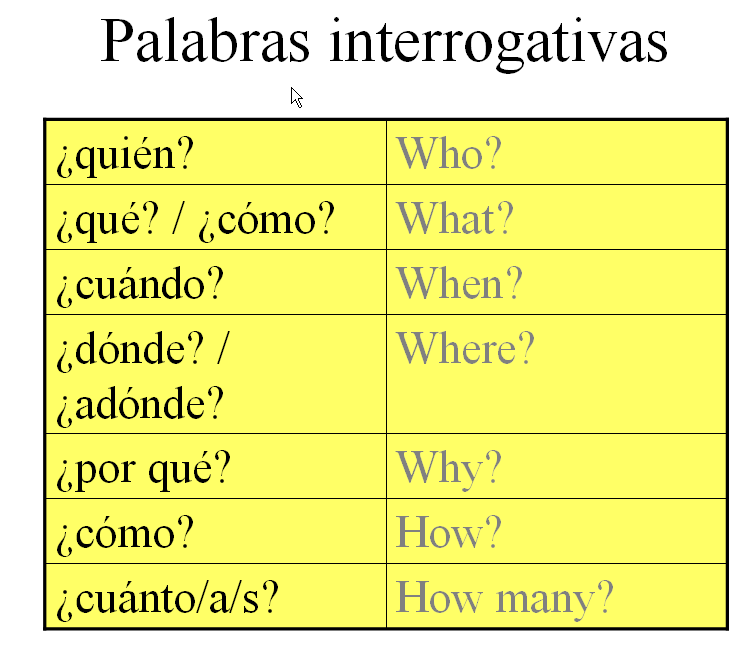
- Question
words:
How many questions
words have we learned (1, 2)? What
is the question word for "do" in Spanish? Can you create a
question with each word? When do you use "qué"
versus "cuál"?
Can you create a question with "yo" as
the subject? Which verb conjugation accompanies "quién" or "quiénes"?
- Possession: How many possessive
adjectives are there? When do you use them? In terms of
adjective/noun agreement, is there anything special to remember about
possessive adjectives?
- Prepositions: Have
you reviewed all of your prepositions of place (under, over, in front of, behind, etc.) (170)?
- Verbs: Have you been
reviewing your AR, ER, and IR verbs? This is our main list.
How many irregular verbs should you know (ser, estar, ir, tener, etc.)? Do you know how
to conjugate as well as determine when to use "ser"
and "estar"? How many
compound verb structures can you create (for example, “tener
ganas de”, “tener que”, “ir a”, “poder”, “deber”, and “necesitar”? Have you studied
all of the idiomatic
expressions you can create with the verb "tener"?
Do you remember how to conjugate stem-changing verbs? Have
you studied the initial list
of stem changing verbs as well as the
second one? Have you practiced generating a question/answer
sequence for each verb? How many GO verbs have we studied? Can you conjugate
these verbs and use them in context? Can you fill-in the blanks in a cloze
paragraph? What are your best
strategies for completing this type of exercise?
- Direct Object Pronouns: What are “transitive verbs” and how do
they limit when you can use a “direct object pronoun”? When and why do we
use “direct object pronouns”? What are the “direct object pronouns” in
Spanish and where do we place them? Which questions can we use so as not
to mistake which object in a sentence is the direct object?
- Demonstrative Adjectives/Pronouns: Did you review the use of demonstrative
adjectives? What is their relationship to the indicators of space (aquí, ahí, allá)? Did you remember that demonstratives can
function as adjectives and therefore must agree in number and gender with
the noun they describe? What is the difference between “ese” and “eso”? How can a
demonstrative adjective be turned into a demonstrative pronoun? Where do you
place the demonstrative pronoun's accent?
- Vocabulary: Have you studied all
the greetings and farewells, titles, and colors (p. 19) in this
Chapter? Have you studied the survival commands that we learned
using the acrostic “Las Vegas Race”? Can you identify all of your
family members by family relationship (brother, brother-in-law,
etc.)? Have you studied enough adjectives to describe your
family members both in terms of physical appearance as well as
personality? Can
you identify the campus buildings in terms of the subject matter taught in
them and give instructions on how to get there to a foreign exchange
student? Have you studied the new vocabulary
related to “pastimes” and “invitations”? Can you write a dialogue in which
you invite your friend/s to participate in a leisure activity? Are there
more polite ways of expressing “querer” in
Spanish? Do you know how to courteously reject an invitation?