August 2019
Monday
Wednesday
Friday
26
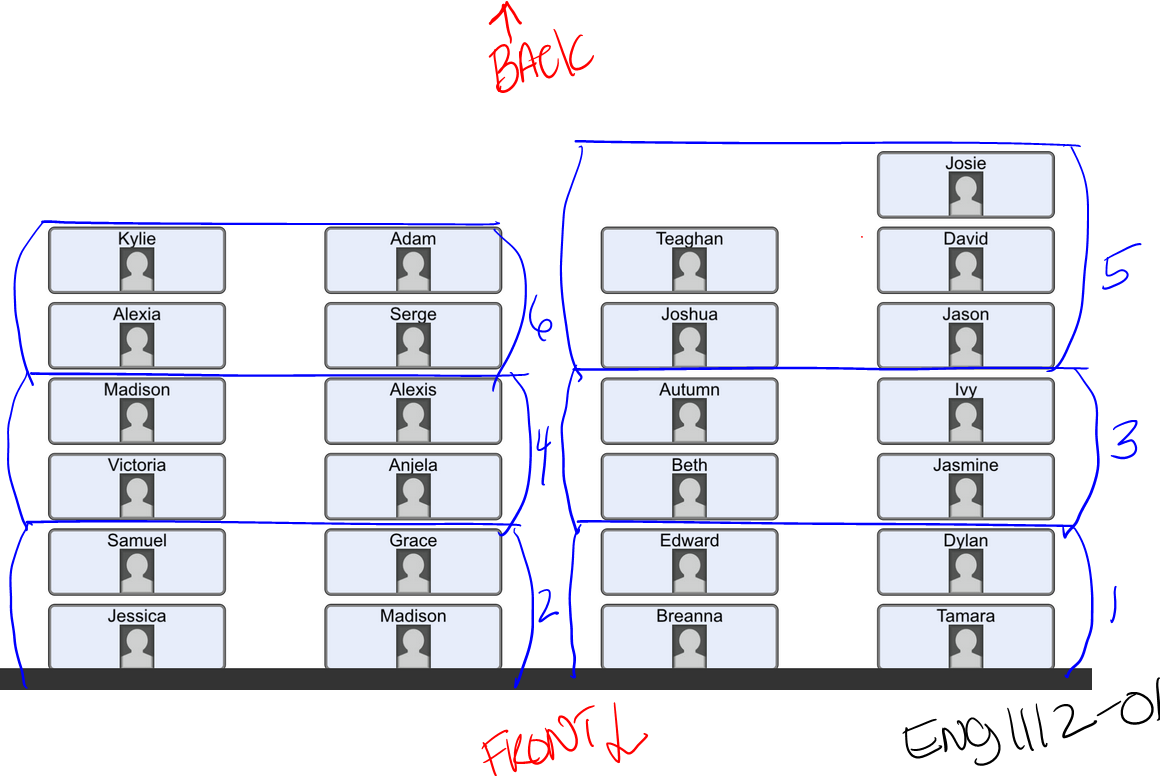
Class Seating / Introduction by group questions / Participation / Syllabus / Quip / D2L / Norton / Icebreakers / Teambuilding / Draw Topics (best friend, dream house, dream job, dream vacation, next big purchase, enjoyable activity)
Purchase your books
Read the syllabus thoroughly and come up with three questions about it for next class
Read: “Reading Critically” NR 26-29
28
Admin: InQuisitive Registration

Syllabus Questions / Quip
Peer Reading Pitfalls: imitating the instructor and acting like an editor.
Types of Reading: read as a "common reader", read to "know the writer"(values, assumptions, opinions and their effect on the text, the writing process and thesis clarity, unknowns), read to "diagnose key problems", and read to "improve paper" (by comparing it to models).
Peer Interaction: summarize, stop and predict, ask questions, label problems, and make suggestions.
30
Recap: Reading & Writing / Rhetoric / Coded Words
Purpose of Norton Reader?
Review: “Reading Critically”`/ rhetoric, rhetorical situation (1) and rhetorical context (purpose [persuasive, argumentative, informative, and aesthetic], audience, genre, stance, argument, assertion, pattern-design-structure, evidence, semantic field)


Why I Write (2) - Orwell / (Atlantic, Prezi, Quizlet)- Orwell / Group Discussion
Begin Semantic Field--Declaration of Independence
Last Day to Add/Drop - Sept 1 st
Read and analyze: Declaration of Independence / Can you determine any semantic fields? / How are it’s paragraphs organized? (Outline of ideas and argument)
September 2019
Monday
Wednesday
Friday
2
Labor Day
4
Admin: Quip? / Thesis Topic?
Is the Declaration of Independence an example of good writing? (1, semantic field)

Key Concepts: semantic field, repetition, paragraph organization, pertinent vs. important
Application for Graduation for May 2020
Read: “Narrating” NR 419-427
6

Thesis Statement: From question to thesis
Narrating Discussion: sequencing (chronological, reverse, flashback), transitions (words, sentences), detail (important vs. pertinent), essay structure (introduction, body, conclusion).
Genre for narratives or recurrent literary form (autobiography, biography (1), life story, short-story, novel [bildungsroman, J ane Eyre, To Kill a Mockingbird, Great Expectations, Little Women, Harry Potter, House on Mango Street], non-ficiton oral history or photo history (1,2))
Then, read this fragment from The Mad King by Edgar Rice Burroughs. This fragment serves as a model narrative.
Finally, reflect on the narrative model and review the paragraphs written by your group members.
Try to give feedback related to spelling, grammar, pertinent details, audience, purpose, style (engaging, concise, etc.), and organization of ideas.
9
Narration: adds a story to other writing (novel, profile, argumentative position paper) / time markers and transitions / pertinent detail / ending
Essay 1: Topic “Profile in Courage” - See Profiles in Courage by JFK (Turn-in using D2L Dropbox) / For advanced essayists (1)
Genre for narratives or recurrent literary form (autobiography, biography (1), life story, short-story, novel [bildungsroman, J ane Eyre, To Kill a Mockingbird, Great Expectations, Little Women, Harry Potter, House on Mango Street], non-ficiton oral history or photo history (1,2))
Our Narrative vs. Literacy Narrative (83)
InQuizitive: Introduction / Editing that matters (Commas) / Comma Splices (assignment)

Read: “Always Living in Spanish: Recovering the Familiar, through Language” by Marjorie Agosín. (Norton 79)
Peer editing–If you haven’t finished editing the narrative paragraphs written in your group, then do so.
11
Quip Feedback
Paramedic Method: practice
Discuss the literacy narrative: “Always Living in Spanish: Recovering the Familiar, through Language” by Marjorie Agosín. (Norton 79) / Isolation / exile / resistance / translation / language-cultural frame
Place your Accident (Narrative) Paragraph in your personal folder.
Read Profiles (Norton 224-234) and consider the place of narration and description in the literary genre called “Profile”.
Work on your Thesis Statement for the Research Paper–due Friday.
Start brainstorming and mind mapping your ideas for Essay 1
13
Class Pics
Dialogue (indirect vs. direct discourse)

Description Exercise: Portrait-Self Portrait / Pair-Pair / Outside Writer
Writing an interesting article for the Newspaper? Genre (content [informative or opinion piece / sports, political, food, fashion, and advice columns], form [headline, byline, lead, explanation, and additional information], stance [viewpoint] / Rhetorical Situation (more details) / Dialogue (indirect vs. direct discourse)
Thesis Statement
(Turn in on D2L)
Revise and add the description exercise done in class to Quip. Then, review the paragraphs written by your group members and provide constructive suggestions/editing.
Challenge: Can your group create a newspaper version of the description that merges the information gained from each writing viewpoint (outside-inside)? What is your stance and purpose? Where does it fit into the newspaper? Have you included any quotations?
Write a Rough Draft of Essay 1
Finish and group edit the Challenge: Can your group create a newspaper version of the description that merges the information gained from each writing viewpoint (outside-inside)? What is your stance and purpose? Where does it fit into the newspaper? Have you included any quotations?
Revised your Rough Draft for Essay 1. Consider finding a peer editor.
18
Key Concepts: Ekphrastic Description
Ekphrastic Description: Urn (2) / “Ode on a Grecian Urn” - Keats


Write an ekphrastic description for Vermeer’s Milkmaid and place it on Quip. If you are still working on your Essay, make sure this is done by Saturday.

Then, read: “Cezanne's Ports” and look at “Three for the Mona Lisa”
Review the paragraphs written by your group members and provide constructive suggestions / editing
20
Preliminary Bib / MLA / Zotero / Sample Preliminary Bibliography
Key Concepts: Discourse, Metaphor, Nash’s typology of paragraphs
Essay 1
(Turn in on D2L)
Last Day for Incomplete Grades
Read: “Writing as Inquiry” Norton (281-4) / “Coming up with a Topic” through “Drafting a Tentative Thesis” (437-441)
Read: Nash
InQuizitive:Fused (Run-on) Sentences / Mixed constructions
Work on the Preliminary Bibliography
23
Key Concepts: Discourse, Metaphor, Nash’s typology of paragraphs
Review: Nash's Metaphors of Paragraph Structure / Step versus stack / Chain / Jelly Bean / A Confederacy of Dunces / Genesis / American Tabloid / A Farewell to Arms / Tale of Two Cities / Pick-up / Notes from the Underground
Last Day for Credit by Exam
If we didn’t finish the Online quiz, then finish it.
Read “Rebel Music” by Daniel Felsenfeld, Norton (640-643)
Work on your Preliminary Bibliography
25
Daniel Felsenfeld Questions – Genre and Music Literacy
Return to More phrases and clauses (focus infinitive, gerund, and participle phrases)
Key concepts: Person, Voice, Point of View / Stance (1,2, 3, 4) / How is stance related to person, voice, and point of view? Persona (1)?


Creating the Preliminary Bibliography: Questions?
Read “Stance”, Norton (64-67
Read “S-5 Subject-Verb Agreement” Norton (HB 24-28)
Work on your Preliminary Bibliography
27
Review: Person, Voice, Point of View, Stance, and Person
Divide the class and use the video to write a paragraph from each different person. / Now try persona (cat, grandmother, etc.)


Look back: Run-on Sentences
Academic Writing and the First Person
Preliminary Bibliography
Read Heidi Pollock’s article “You Say You Want a Resolution?” (803), clearly identify the Person, Voice, and Point of View. Prepare to answer questions in class
Quip: Add the group paragraphs from class..